Last year was quite a year.
It didn’t start the way I hoped, and while that was difficult, I learned a lot about myself (see my first article on perfectionism for example), what was important, and who I want to be.
Reflecting on those things has led to a single word getting stuck in my brain.
Intentional.
What would it mean for me to be intentional in what I do every day?
It is so easy to just go through the motions. Letting the weeks blur together. Reacting to life as it comes. Always feeling like I have one too many things on my plate. Always behind.
Instead of reacting, I want to proactively set an intention. So I’ve been asking myself, what would an intentional year look like?
Past frustrations
I have found that I can be an all-or-nothing person. When something excites me, I want to go all in.
If I decided to set a daily fitness goal, it wouldn’t be enough to start with three sets of 20 push-ups. Instead, I’d spend weeks researching the perfect exercise routine. I’d commit to working out for at least an hour every day. And of course, if I’m focusing on fitness, I should probably track my macros as well. Maybe make a meal plan too.
This works great for about three days.
Then my inconsistent execution makes it feel like I’m failing my own plan. I get frustrated. Instead of reining it back in, I stop altogether.
It could be fitness, relationships, work, or finances. I swing like a pendulum, going all in and overdoing it, then overcorrecting and setting the whole plan to the side. I don’t consider myself a “quitter”, but this has happened often enough to be a pattern.
I’ve been aware of this for a while, but often think next time will be different.
I just need to structure my calendar better.
Maybe doing it in the morning is better than the afternoon.
I’ve tried the tweaks and the hacks. They haven’t made a meaningful difference.
So how do I create change that actually lasts? How do I break my streak of the big swing followed by the inevitable strikeout?
Maybe I need to start a bit smaller.
That feels wrong. I want to make big changes. I want to do things that matter. There’s no time for small things—especially when it feels like I’m behind and trying to make up for lost time.
Focusing on identity
My problem, I’ve realized, is that I’ve focused on changing my goals, and sometimes my habits, but haven’t gone deeper.
I’ve been reading James Clear’s Atomic Habits, and he argues that change happens at three levels.
The first is outcomes: what you get. Most goals fall here, like “lose twenty pounds.”
The second is processes: your systems or habits, like “go to the gym every day”.
The third, and deepest level, is identity: what you believe about yourself.
Most of us try to change by focusing on what we want to achieve, which is outcome-focused. We might also consider how we want to get there, which is process-focused.
But we often ignore identity, and as Clear says, “Good habits can make rational sense, but if they conflict with your identity, you will fail to put them into action.”
If what I believe about myself is “I’m the kind of person who’s all-or-nothing”, then that is part of my identity.
And being all-or-nothing has often ended with nothing.
Clear likens our actions to “votes” that we cast for the person we want to become. Every time I get frustrated and quit, I cast another vote reinforcing that identity.
Each time I don’t stick with my plan, I’m unintentionally telling myself that I’m the kind of person that struggles to stick with things.
More succinctly: I am undisciplined.
My goals and habits might make sense, but if if my underlying identity doesn’t align with them, it will be an uphill battle.
No wonder the cycle keeps repeating.
If I want different results, I don’t need better goals. I need a new identity.
Keystone habits
This is where the idea of a keystone habit comes in.
This term comes from Cal Newport, another author and thinker I admire. Instead of an approach that you take, he describes discipline as an “identity that you develop” on an episode of his podcast, Deep Questions.
If you want to make meaningful change, you have to first convince yourself that you are a disciplined person.
Trying to force discipline by picking an ambitious goal doesn’t work because there’s no foundation to support it. Or, back to Atomic Habits, “Behavior that is incongruent with the self will not last.”
Newport suggests identifying the key areas of your life—health, relationships, spirituality, and so on—and choosing a single keystone habit for each.
These habits should be manageable and realistic, but not trivial.
Someone who hasn’t worked out consistently shouldn’t commit to an hour-long, self-designed fitness plan while tracking macros and meal prepping… which may sound familiar.
On the other hand, a habit of a single squat a day wouldn’t be meaningful.
A keystone habit shouldn’t be everything you want to accomplish in that area. It’s simply a signal to yourself that you take that area seriously.
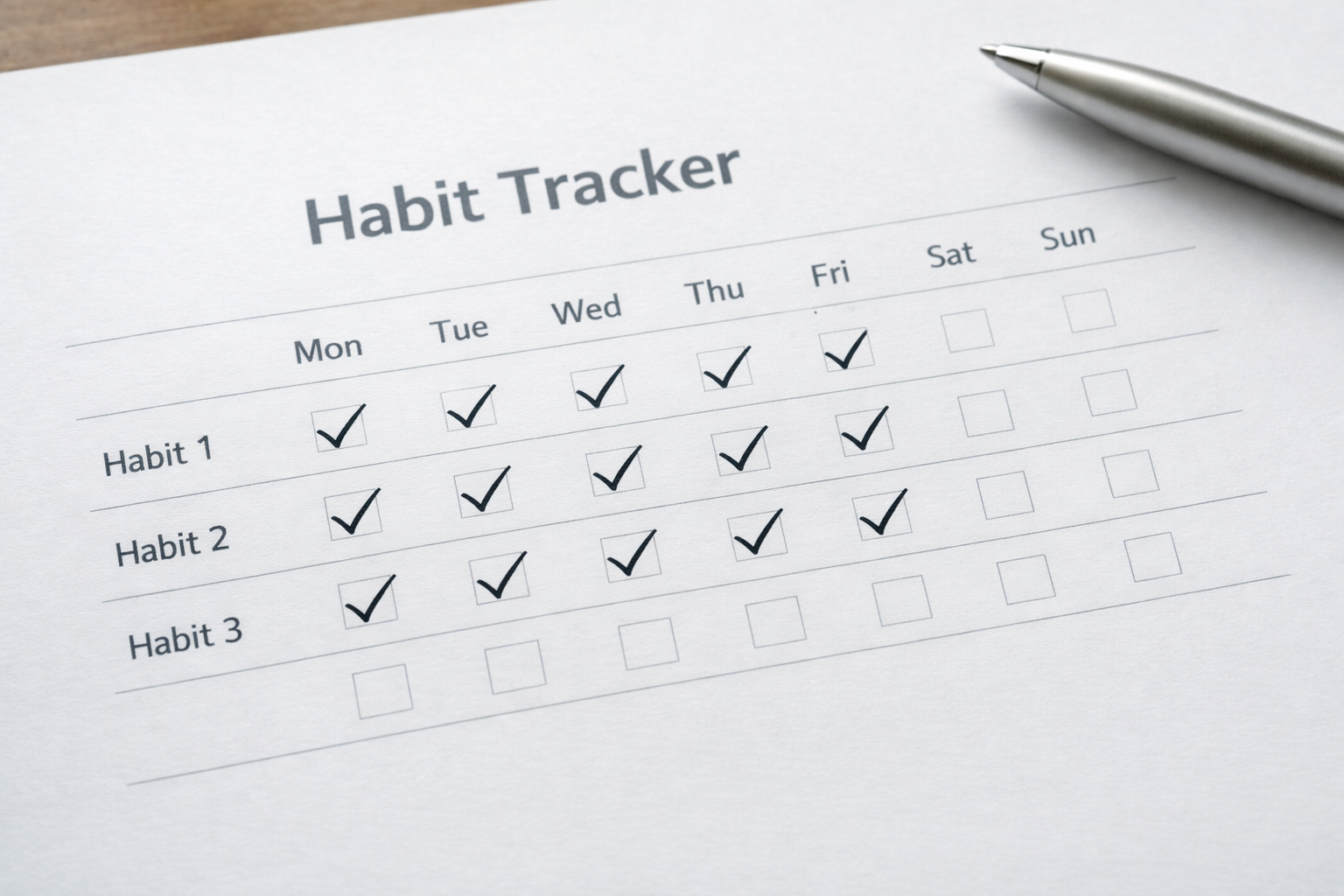
The goal is consistency. Do the keystone habits daily. Track them. Don’t break the chain.
Over time, you demonstrate to yourself that you can do hard things that reflect your values. There is literally “evidence” in the form of that habit tracker. This proof supports a new identity.
An identity of discipline.
Only after that foundation exists do larger goals make sense.
Casting new votes
Clear says it plainly: “New identities require new evidence. If you keep casting the same votes you’ve always cast, you’re going to get the same results you’ve always had.”
His process for creating a new identity is simple:
- Decide who you want to be
- Prove it to yourself with small wins
Instead of setting a single, ambitious goal for the year, I’m focusing on building an identity of discipline. Larger goals will follow when I’m ready for them.
For now, I’m choosing to focus on one key area: physical health. This is an area where I’ve made progress before, relapsed, and started over, usually by trying to do too much at once.
This time, I’m intentionally limiting what I take on until my identity catches up.
My keystone habit will be doing a simple bodyweight and dumbbell workout. No more than 15 minutes a day (with intentional rest on Sunday).
Each day I do this, I cast votes for a new identity. Over time, I will revisit this key area, add more key areas, and keystone habits. But only after discipline becomes part of who I believe I am.
Next steps
What is an area of life you value, and what single keystone habit could help you build your own identity of discipline?
It might feel insignificant. But I’ll leave you (and myself) with one more reminder from Atomic Habits:
“Small habits can make a meaningful difference by providing evidence of a new identity. And if a change is meaningful, it actually is big.”