Blog

  • Casting Votes with Keystone Habits

    Casting Votes with Keystone Habits

    Last year was quite a year.

    It didn’t start the way I hoped, and while that was difficult, I learned a lot about myself (see my first article on perfectionism for example), what was important, and who I want to be.

    Reflecting on those things has led to a single word getting stuck in my brain.

    Intentional.

    What would it mean for me to be intentional in what I do every day?

    It is so easy to just go through the motions. Letting the weeks blur together. Reacting to life as it comes. Always feeling like I have one too many things on my plate. Always behind.

    Instead of reacting, I want to proactively set an intention. So I’ve been asking myself, what would an intentional year look like?

    Past frustrations

    I have found that I can be an all-or-nothing person. When something excites me, I want to go all in.

    If I decided to set a daily fitness goal, it wouldn’t be enough to start with three sets of 20 push-ups. Instead, I’d spend weeks researching the perfect exercise routine. I’d commit to working out for at least an hour every day. And of course, if I’m focusing on fitness, I should probably track my macros as well. Maybe make a meal plan too.

    This works great for about three days.

    Then my inconsistent execution makes it feel like I’m failing my own plan. I get frustrated. Instead of reining it back in, I stop altogether.

    It could be fitness, relationships, work, or finances. I swing like a pendulum, going all in and overdoing it, then overcorrecting and setting the whole plan to the side. I don’t consider myself a “quitter”, but this has happened often enough to be a pattern.

    I’ve been aware of this for a while, but often think next time will be different.

    I just need to structure my calendar better.

    Maybe doing it in the morning is better than the afternoon.

    I’ve tried the tweaks and the hacks. They haven’t made a meaningful difference.

    So how do I create change that actually lasts? How do I break my streak of the big swing followed by the inevitable strikeout?

    Maybe I need to start a bit smaller.

    That feels wrong. I want to make big changes. I want to do things that matter. There’s no time for small things—especially when it feels like I’m behind and trying to make up for lost time.

    Focusing on identity

    My problem, I’ve realized, is that I’ve focused on changing my goals, and sometimes my habits, but haven’t gone deeper.

    I’ve been reading James Clear’s Atomic Habits, and he argues that change happens at three levels.

    The first is outcomes: what you get. Most goals fall here, like “lose twenty pounds.”

    The second is processes: your systems or habits, like “go to the gym every day”.

    The third, and deepest level, is identity: what you believe about yourself.

    Most of us try to change by focusing on what we want to achieve, which is outcome-focused. We might also consider how we want to get there, which is process-focused.

    But we often ignore identity, and as Clear says, “Good habits can make rational sense, but if they conflict with your identity, you will fail to put them into action.”

    If what I believe about myself is “I’m the kind of person who’s all-or-nothing”, then that is part of my identity.

    And being all-or-nothing has often ended with nothing.

    Clear likens our actions to “votes” that we cast for the person we want to become. Every time I get frustrated and quit, I cast another vote reinforcing that identity.

    Each time I don’t stick with my plan, I’m unintentionally telling myself that I’m the kind of person that struggles to stick with things.

    More succinctly: I am undisciplined.

    My goals and habits might make sense, but if if my underlying identity doesn’t align with them, it will be an uphill battle.

    No wonder the cycle keeps repeating.

    If I want different results, I don’t need better goals. I need a new identity.

    Keystone habits

    This is where the idea of a keystone habit comes in.

    This term comes from Cal Newport, another author and thinker I admire. Instead of an approach that you take, he describes discipline as an “identity that you develop” on an episode of his podcast, Deep Questions.

    If you want to make meaningful change, you have to first convince yourself that you are a disciplined person.

    Trying to force discipline by picking an ambitious goal doesn’t work because there’s no foundation to support it. Or, back to Atomic Habits, “Behavior that is incongruent with the self will not last.”

    Newport suggests identifying the key areas of your life—health, relationships, spirituality, and so on—and choosing a single keystone habit for each.

    These habits should be manageable and realistic, but not trivial.

    Someone who hasn’t worked out consistently shouldn’t commit to an hour-long, self-designed fitness plan while tracking macros and meal prepping… which may sound familiar.

    On the other hand, a habit of a single squat a day wouldn’t be meaningful.

    A keystone habit shouldn’t be everything you want to accomplish in that area. It’s simply a signal to yourself that you take that area seriously.

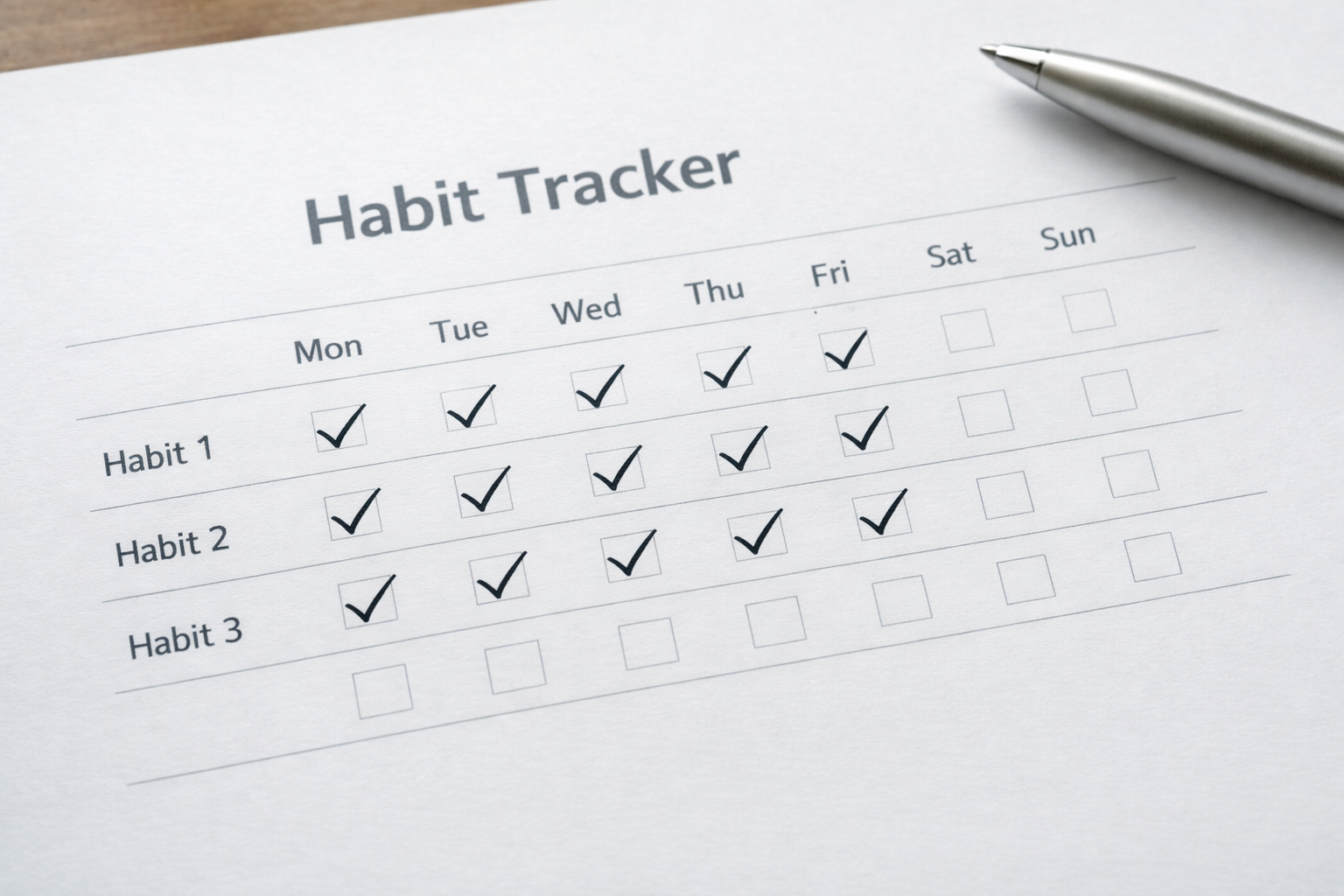
    The goal is consistency. Do the keystone habits daily. Track them. Don’t break the chain.

    Over time, you demonstrate to yourself that you can do hard things that reflect your values. There is literally “evidence” in the form of that habit tracker. This proof supports a new identity.

    An identity of discipline.

    Only after that foundation exists do larger goals make sense.

    Casting new votes

    Clear says it plainly: “New identities require new evidence. If you keep casting the same votes you’ve always cast, you’re going to get the same results you’ve always had.”

    His process for creating a new identity is simple:

    • Decide who you want to be
    • Prove it to yourself with small wins

    Instead of setting a single, ambitious goal for the year, I’m focusing on building an identity of discipline. Larger goals will follow when I’m ready for them.

    For now, I’m choosing to focus on one key area: physical health. This is an area where I’ve made progress before, relapsed, and started over, usually by trying to do too much at once.

    This time, I’m intentionally limiting what I take on until my identity catches up.

    My keystone habit will be doing a simple bodyweight and dumbbell workout. No more than 15 minutes a day (with intentional rest on Sunday).

    Each day I do this, I cast votes for a new identity. Over time, I will revisit this key area, add more key areas, and keystone habits. But only after discipline becomes part of who I believe I am.

    Next steps

    What is an area of life you value, and what single keystone habit could help you build your own identity of discipline?

    It might feel insignificant. But I’ll leave you (and myself) with one more reminder from Atomic Habits:

    “Small habits can make a meaningful difference by providing evidence of a new identity. And if a change is meaningful, it actually is big.”

  • From Money to Life Energy – The Real Cost of Your Spending

    From Money to Life Energy – The Real Cost of Your Spending

    Let’s say I have a brand-new car. You’ve been in the market for a while, and I’ve got the best deal in town.

    You can drive it home today for an incredibly low price. No money down, no interest. I don’t even care about your credit score.

    The price?

    One year of your life.

    Would you take me up on it?

    Forget the car for a moment. How much of your time would you trade for a nice vacation? A new pair of shoes? A fancy dinner out?

    Would you give an hour of your life for a meal driving home from work? A week for that dream trip to the beach?

    In reality, when we want those things, we just swipe our credit card. It couldn’t be easier.

    As long as we can afford the payment at the end of the day, what does it matter? We work hard, so it’s worth it.

    Or is it?

    This summer, I read Your Money or Your Life by Vicki Robin. She argues that because we sell our time for money, money is really life energy.

    We may not literally spend hours and minutes as currency, but every time we spend money, we’re spending pieces of our life.

    At first, this sounds obvious. Of course we trade time for money. We call it an hourly wage.

    What’s less obvious is how much money we truly earn for the time we give up.

    Meet Sam

    This is Sam.

    Sam works in an office, doing office-type things. He makes $80,000 a year working 40 hours a week.

    To calculate his hourly wage, we’ll divide his income by the number of hours he works in a year:

    • $80,000 ÷ 2,080 (52 weeks x 40 hours) = $38.46 per hour

    Not bad!

    But that number doesn’t tell the whole story.

    We all know about “cost of living” — groceries, rent, healthcare. But there’s another category most people overlook: cost of working.

    Cost of working includes any expenses you incur only because you have a job.

    There are obvious expenses, like transportation , professional clothing, and the 2 pm coffee to get you through the afternoon.

    Less obvious ones might be eating dinner out because you’re too tired to cook, or retail therapy over the weekend to blow off steam.

    Some expenses will vary by person. Would you get your hair cut as often if you weren’t working? If not, that’s a work expense.

    What about your vacation? If it’s really just a time to get away from work and recover from burnout, it might be a work expense.

    Include your time in your cost of living calculation, and you’ll consider commute time, time getting ready for work, time to decompress after work, time that work lives rent-free in your head…

    You get the point.

    Real Hourly Wage

    When we subtract our cost of working, both time and money, from our income, we get what Vicki Robin calls your “real hourly wage”.

    Let’s apply this to Sam.

    He says he works 40 hours a week, but in reality, he’s been staying late — about an extra hour each day.

    His 10-mile commute takes about 30 minutes due to traffic. He figured that if he was going to be spending an hour in traffic every day, he deserves to be comfortable. So he upgraded from his old college car, and his payment costs $500 a month.

    Work has been stressful lately, so he tries to get himself out of the office and goes for walk. He found a nice coffee shop just three minutes away. He gets a $6 drink there about twice a week, and usually grabs one of those $8 sandwiches as well since it’s convenient.

    By the end of the day, Sam is too drained to cook, spending $45 a week on takeout. It usually takes another 30 minutes in front of the television once he’s home to totally decompress.

    To “dress for the job he wants,” he budgets $50 a month for professional clothes. It takes about 30 minutes getting ready for work each day between shaving, changing, and trying to keep his tie-tying attempts to less than three.

    Sam has always wanted to go on a really incredible vacation, but he’s just so tired. Maybe one day he’ll take a month and backpack across Europe. Instead, he just takes his time off and uses it as a chance to get a break and recover before getting back to the grind. At least he usually gets a good view from his beach chair! Sam’s “vacations” usually cost him about $2,000 each year.

    Before, we said that Sam works 40 hours a week for $80,000. Now that we have this extra information, let’s make some adjustments.

    Let’s tally his annual job-related expenses:

    • $6,000 – car payment
    • $3,640 – mileage to and from work
    • $1,456 – coffee & lunches
    • $2,340 – takeout
    • $600 – professional wardrobe
    • $2,000 – recuperation with a view
    • $9,000 – to the other Sam (Uncle Sam)

    That’s $25,036 just to maintain his job.

    Subtract that from his $80,000 salary, and Sam’s adjusted income is $54,964.

    Now let’s adjust his time: 40 work hours plus an extra five hours a week, plus commuting, getting ready, and decompressing — roughly 55 hours per week.

    That’s 2,860 hours per year.

    Here’s Sam’s real hourly wage:

    • $54,964 ÷ 2,860 hours = $19.22 per hour

    That is LESS THAN HALF of the hourly wage we calculated earlier!

    The True Cost: Life Energy

    Now, let’s take it one step further.

    We can take that real hourly wage and convert it into life energy:

    • 60 minutes ÷ $19.22 = 3.12 minutes per dollar

    Every dollar Sam spends costs just over 3 minutes of his time. This is the real cost that he needs to consider whenever he buys something.

    $14 at the coffee shop? 44 minutes. A $200 concert ticket? Nearly 11 hours.

    Maybe those things are worth it — only Sam can decide. But at least he now understands the true cost.

    Our life energy is nonrenewable. You can always earn more money, but you can’t earn more time.

    So, reframing purchases in terms of life energy forces us to ask: is this really worth it?

    Understanding the Alternative

    It’s easy to dismiss this as a thought exercise. After all, we need to spend money on something — and it feels good to reward ourselves after working hard.

    Without an alternative, what’s the point?

    Again, we need to make sure we understand the cost.

    Let’s do one more thought exercise.

    If money weren’t a factor, how would you spend your life energy?

    Would you spend more time with family? Travel? Finally learn to play the guitar?

    Maybe you’ve always wanted to get more involved in your community or church, or to volunteer with a local organization.

    If you weren’t working, how would that impact your mental health? Would you be less stressed? Anxious? Tired? Frustrated?

    How about physical health? You could finally take the time to train for that 5k your friend invites you to every year. You could try some of the recipes you pinned to your Pinterest board, or maybe actually catch up on your sleep.

    Ultimately, most of us would focus on one thing: whatever we value.

    This is the alternative, and this is why real hourly wage and life energy matter.

    So, instead of that coffeeshop lunch, what if you could buy back your time?

    How much would you pay to have freedom and options?

    Enter Financial Independence.

    Financial Independence, or FI, is the idea of no longer needing to trade your time for money. You can still work if you want — but you don’t have to.

    FI gives you freedom — the ability to spend your life energy on what matters most.

    This might sound unrealistic, unbelievable, or simply unattainable.

    This is one of the reasons I decided to start writing.

    I want to show that it is not just possible but practical.

    I plan to chronicle mine and my wife’s journey to FI — the choices we make, the challenges we face, and the lessons we learn along the way.

    The formula to get to FI is simple: increase your income, minimize your expenses, and invest the difference.

    Simple, but not easy — and everyone’s path looks different.

    I’ll be writing more about the fundamental formula of FI and how my wife and I are utilizing it. I’ve found there is a lot to learn, and a nearly infinite number of ways to implement them.

    As I share our experience, I hope you’ll join in and share yours.

    Your Turn

    Try calculating your own real hourly wage. Are you surprised by the result?

    How does this reframe your purchases?

    What are you willing to trade your time for — and what might you choose to skip if it meant buying back your freedom?

    Let me know in the comments, and check back soon for more as we break down the FI formula of increasing income, minimizing expenses, and investing the difference.

  • Removing the Mask – What My Perfectionism Was Really Hiding

    Removing the Mask – What My Perfectionism Was Really Hiding

    This is my first post. I’m not sure I like how it turned out.

    I’ve never built a website before, either. I made the header blue, and I’m not sure if that’s weird.

    The first few sentences above came to me pretty quickly, and I even kind of like how I started. But now, I’m second-guessing everything—writing, deleting, outlining, shuffling, reordering, rephrasing, and then deleting again.

    I’m a bit of a perfectionist. If you know me, that’s not a shocking statement. It’s been part of my so-called “process” since college—probably even earlier.

    What is shocking is how long it’s taken me to recognize what my perfectionism was hiding.

    My process wasn’t productivity. It was me spinning my wheels. I analyzed, revised, and iterated. Again and again.

    I did that because I had high expectations. I was detail-oriented. I wore “perfectionism” like a badge of honor. I embraced it. After all, it was necessary if I wanted to accomplish and achieve my goals. I wouldn’t just meet the standard; I would blow past it and set a new one.

    Or at least, that’s what I told myself.

    2025 started rough. Brutally rough. I had just begun settling into a new role at work when my entire environment shifted. What followed was incredibly stressful, overwhelming, and exhausting. It was the worst couple of months in my entire life.

    No matter what I did or how hard I worked, it was never enough. I gave everything I had. Yet, I still felt like a complete failure.

    I’ve dealt with disappointing outcomes before. Normally, I could live with them if I knew I worked hard. But this time it was different. Doing my best—and knowing I had—wasn’t enough. Instead, it felt like my world was falling around me.

    I was rapidly burning out. Thankfully, a very timely vacation and an unexpected change at work prevented that.

    In the months since, I have been resting, recuperating, and reflecting. And I’ve realized that what I told myself about my perfectionism wasn’t the full truth.

    There was nothing wrong with having high standards or wanting to do my best. The problem wasn’t my desire to succeed. That just wasn’t the whole story.

    The reality is, I wasn’t striving to succeed—I was striving to be seen as successful. I wanted others to think I was competent, capable, and impressive. Perfectionism wasn’t a badge of honor. It was a mask. It hid my insecurity and pride under the surface.

    That mask may have fooled others sometimes, but mostly, it fooled me.

    It let me paint myself in the best possible light. It convinced me I was confident. But really, I cared more about what other people thought of me than I realized.

    It’s genuinely difficult to admit that. Even now, part of me doesn’t want to share this.

    I don’t want to hit “publish” until everything is perfect. I still feel like I should watch seven hours of YouTube tutorials on formatting WordPress headers. Maybe design a logo. Learn SEO. Take a writing class.

    There is always something else I could do. Some excuse for why it’s not ready yet.

    But I want to do something different.

    So, I am posting this before feeling like I have everything figured out. This might seem like a small step. In some ways it probably is.

    But this is my attempt to lean into “imperfectionism”. I’m trying to share a work in progress instead of a finished product.

    I’m trying to embrace people seeing me as a work in progress.

    So, here are some obvious truths:

    • The design of my website isn’t great.
    • This article will probably make me cringe later.
    • I don’t really know how to blog.

    And here are some harder truths—ones I don’t like admitting:

    • I haven’t always been driven by a desire to succeed, but by a desire to be perceived as successful.
    • I convinced myself that I was doing my best, but was just trying to demonstrate competence to others.
    • I prioritized the wrong things and wasted time and energy because I thought others would notice.

    This is me. Mask off. And very uncomfortable.

    I am separating my desire to do my best from my desire to demonstrate my competence. They’re not the same thing, and I’m only just starting to recognize that.

    So here we are. Welcome to Refining Daily. This is my place to experiment, have fun with writing, and share what I’m learning with anyone who wants to listen.

    I have no idea what this imperfect site and article are going to turn into. Maybe it will resonate with you, maybe not. Maybe thousands of people will read this, or maybe just my mom. Either way, I’m glad to finally admit this—and move forward.

    I’ve come to see that my perfectionism was less about standards and more about appearance. Have you ever noticed that in yourself too?

    I’d love to hear about it in the comments.